"We solved the problem of fragmented, outdated, and non-adaptive AIBE exam preparation for 2,50,000+ annual candidates by engineering a Generative AI platform that auto-produces structured legal study content across 19 subjects, intelligently extracts questions from scanned documents, adapts test difficulty per student in real-time, and provides 24/7 AI tutoring — reducing content creation cost by 95% and time-to-market by 90% while delivering measurably higher pass rates than the national average. "
Overview
AIBE Pro (aibepro.in) is an AI-engineered exam preparation platform built exclusively for the All India Bar Examination — the mandatory qualifying exam for 2,50,000+ law graduates annually in India. Unlike generic edtech platforms that treat AIBE as a side offering, AIBE Pro uses Generative AI as the core production engine — AI generates the study content, AI powers the tutoring, AI extracts questions from documents, AI translates across languages, AI adapts difficulty to individual learners, and AI predicts pass probability. The platform covers all 19 AIBE subjects including the new criminal codes (BNS, BNSS, BSA) that replaced IPC, CrPC, and the Evidence Act in July 2024.
Problem
India produces over 2,50,000 AIBE candidates every year, with approximately 77,000 failing each cycle (31% failure rate). The preparation ecosystem is fragmented: students rely on scattered PDFs, outdated bare act commentaries, random YouTube videos, and generic test-series apps that treat AIBE as an afterthought. Three specific problems compound this failure rate:
First, the July 2024 replacement of IPC, CrPC, and the Evidence Act with BNS, BNSS, and BSA created an immediate content void — the entire legal study material ecosystem became outdated overnight, and no platform had comprehensive updated content.
Second, AIBE tests 19 distinct law subjects in an open-book format (100 MCQs in 3.5 hours), requiring not just legal knowledge but speed in locating Bare Act sections. No preparation tool trained students for this specific skill.
Third, creating structured study content for 19 legal subjects — notes, MCQs, case law summaries, PYQ explanations, flashcards, and translations — would traditionally require a team of 15-20 legal content writers working for 6-12 months, making the venture economically unviable for a bootstrapped startup.
Challenges
-
Content scale vs. team size
19 subjects, each with 8-25 topics, each topic with 4-18 sub-topics — resulting in 200+ content units. Each unit needs comprehensive notes (2,000-4,000 words), 20-50 MCQs with explanations, case law mappings, revision notes, and flashcards. Total content volume: approximately 500,000+ words of legal text, 5,000+ MCQs, 4,900+ case law summaries. Building this manually was infeasible for small team. -
Legal accuracy at AI scale
Generative AI models hallucinate. In a legal education context, a hallucinated Bare Act section number, an incorrect case citation, or a wrong legal principle can directly cause exam failure. Every AI-generated content piece needed a validation and review pipeline that caught legal inaccuracies without creating a manual bottleneck. -
New criminal code coverage gap
BNS (358 sections replacing IPC's 511), BNSS (531 sections replacing CrPC's 484), and BSA (170 sections replacing Evidence Act's 167) had been in effect for less than a year. AI models' training data had limited coverage of these codes. The system needed to generate accurate content about legislation that didn't exist in the training corpus. -
Document intelligence
AIBE previous year question papers exist as scanned PDFs and DOCX files with inconsistent formatting. Extracting individual questions, identifying options, mapping to subjects/topics, and generating explanations required an OCR + NLP + legal-domain extraction pipeline. -
Adaptive personalization
Each student has different weak areas across 19 subjects. Static content serves everyone the same way. The platform needed per-student adaptive testing and recommendation without building a traditional ML pipeline with training data it didn't yet have. -
Multi-language legal content
AIBE candidates span India's linguistic diversity. Hindi translation of legal content isn't simple text translation — legal terminology (Bare Act section names, Latin maxims, case citations) must be preserved verbatim while explanatory text is translated naturally.
Solution
The platform was delivered as an AI-engineered legal education ecosystem built around content generation, intelligent learning assistance, adaptive assessments, and predictive analytics. Generative AI operates across multiple layers of the platform, while structured validation workflows ensure educational accuracy, consistency, and quality before content reaches learners.
- Multi-Layer AI Architecture
AIBE Pro was built as an AI-engineered platform where Generative AI operates at seven distinct layers: content generation, document extraction, adaptive testing, intelligent tutoring, translation, revision synthesis, and predictive analytics. - Purpose-Built AI Workflows
Each layer uses purpose-built prompting strategies, validation pipelines, and human-in-the-loop review workflows. - AI-First Content Creation
The architecture follows a "Generate Maximum, Review Everything, Edit Anything, Publish Confidently" philosophy. - Automated Content Generation
AI produces the first draft of every content piece. - Human Validation Interface
A structured review interface enables rapid human validation. - Controlled Publishing Pipeline
A version-controlled publishing pipeline ensures only verified content reaches students.
Architecture
The platform combines a modern full-stack web architecture with AI-powered learning workflows. Next.js handles both public-facing and authenticated experiences, while Supabase and PostgreSQL provide a scalable foundation for content, users, assessments, and analytics.
Next.js 14 (TypeScript) - Full-stack web application
Tailwind CSS & shadcn/ui - Responsive user interface
Supabase PostgreSQL - Content · Users · Assessments · Analytics
Prisma ORM - Database access & schema management
NextAuth.js - Google OAuth & Phone OTP authentication
Cloudflare R2 - Document & media storage
Razorpay - Payment processing & subscriptions
Vercel Edge Functions - Serverless APIs & scalable deployment
AI Services Layer - Content Generation · Tutoring · Translation · Analytics
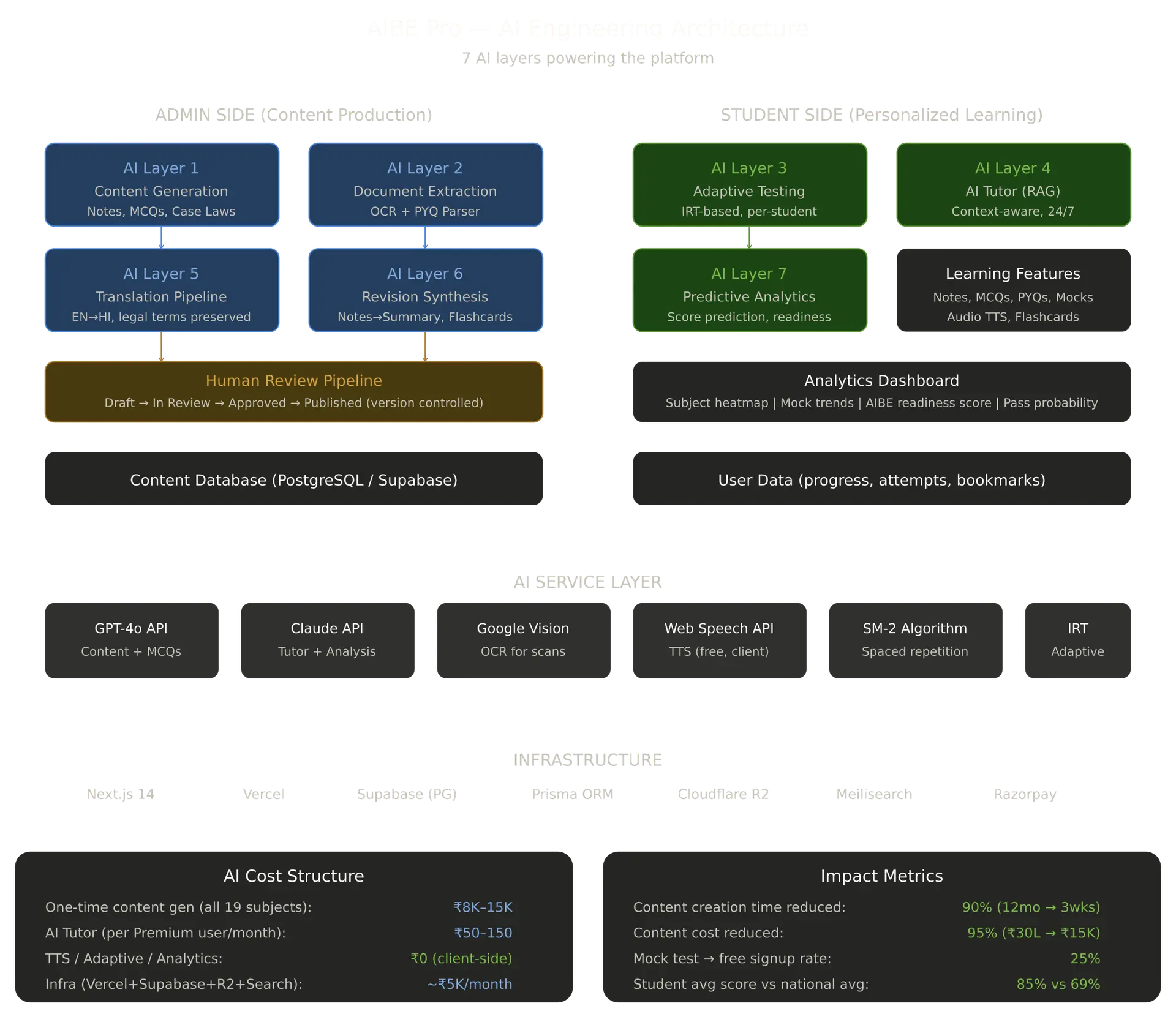
AI & Machine Learning Implementation
The platform leverages Generative AI across content creation, assessment, tutoring, translation, revision, and analytics workflows. Each AI capability is supported by validation pipelines and human review mechanisms to maintain educational accuracy and reliability.
- Content Generation Engine
AI-powered generation of notes, topics, MCQs, and legal content using specialized prompts aligned with AIBE patterns, Bare Acts, and legal writing standards. - Document Extraction Pipeline
OCR and LLM-based processing of previous-year question papers, automatically extracting questions, options, subjects, and topics with human review before publication. - Adaptive Testing Engine
Dynamic difficulty adjustment using a real-time ability estimation model that personalizes assessments based on student performance. - AI Tutor (Conversational RAG)
Context-aware legal assistant providing topic-specific guidance, Bare Act references, and learning support within the student's current study context. - Translation Pipeline
AI-driven English-to-Hindi translation with preservation of legal terminology, case citations, statutory references, and legal concepts. - Revision & Memory System
Automated generation of revision notes, flashcards, and spaced-repetition learning schedules to improve retention and exam readiness. - Predictive Analytics
Performance forecasting models that estimate exam readiness, score ranges, pass probability, and learning trends from student activity and assessment data. - Search & Learning Infrastructure
High-performance search across study materials, case laws, and question banks, supported by notifications and audio-learning capabilities.
Key Features
- AI-generated study notes for all 19 AIBE subjects with Bare Act cross-references, case law citations, and highlighted key points — covering new criminal codes (BNS, BNSS, BSA) with old-vs-new comparison tables
- 5,000+ practice MCQs with difficulty tagging, detailed explanations, Bare Act section references, and AI-powered duplicate detection across the question bank
- Document upload and intelligent extraction pipeline for PYQ papers — OCR for scanned documents, LLM-based question extraction, automated subject/topic mapping with admin review interface
- Dynamic mock test engine with configurable parameters (question count, time limit, difficulty distribution, subject selection, negative marking) and a pre-configured AIBE Full Mock template matching the real exam pattern
- Adaptive testing engine using simplified IRT that adjusts question difficulty in real-time based on the student's running ability estimate — focuses practice on weak subjects automatically
- AI tutor chatbot with conversation context awareness, Bare Act-referenced responses, and rate limiting for cost management
- Multi-language content pipeline with legal terminology preservation for English-to-Hindi translation
- Spaced repetition flashcard system (SM-2 algorithm) with AI-generated cards for legal maxims, case citations, and key provisions
- Performance analytics with 19-subject heatmap, mock test trend tracking, AIBE readiness score (composite metric), and AI-predicted pass probability
- Pass guarantee system on Premium plan with automated eligibility tracking (80% content completion + 5 mock tests)
- Freemium model with content gating: free tier (Chapter 1 per subject + 1 mock test), Starter (Rs 999/year — PYQs + unlimited mocks), Complete (Rs 2,999/year — full content), Premium (Rs 5,000/year — AI tutor + analytics + pass guarantee)
-
SEO-optimized public pages: 19 subject landing pages, PYQ archive with solutions, blog, and free resources hub — all server-side rendered via Next.js for organic student acquisition