"Wesolved the high-effort, manual problem of syllabus and educational content creation using a Next.js, Supabase, and Claude API platform that generates structured, board-aligned syllabi on demand — cutting content creation time by 90% and letting institutes focus on teaching instead of authoring.
Overview
Content Generation is a web application that uses generative AI to produce complete, board-aligned syllabi on demand. For any given combination of standard, college year, and board, the platform instantly generates a structured syllabus — broken down into units, chapters, and topics — that institutes can use as the foundation for their teaching and content workflows. Built for schools, colleges, and education providers, the tool replaces a slow, manual content-authoring process with a few clicks.
Problem
Maintaining syllabi manually is one of the most repetitive and time-consuming parts of running an educational institute. The problem compounds beyond the syllabus itself: every syllabus requires accompanying content at the unit, chapter, and topic level — outlines, learning objectives, and structure — and all of it has to be authored, formatted, and kept current across multiple standards, years, and boards. Faculty and content teams spend enormous effort on this groundwork before any actual teaching can happen, and the work has to be repeated every time a board updates its curriculum.
Challenges
-
Accuracy
AI-generated content in education cannot be approximate — it has to align faithfully with the structure and depth expected for a given board and standard. -
Content Structure
A syllabus isn't free-form text but a hierarchy of units, chapters, and topics, and the system had to produce content in that exact shape, consistently, every time. -
Performance
For the tool to feel useful, generation had to happen on the fly, not in minutes-long batch jobs. -
Data Persistence
Generated content needed to persist in a structured database so institutes could revisit, edit, and build on it rather than regenerating from scratch. -
Scalability
The platform needed to support multiple institutes, boards, standards, and subjects while maintaining consistent generation quality and performance. -
Content Reliability
AI outputs had to remain educationally relevant and context-aware, minimizing inconsistencies and ensuring content remained aligned with syllabus requirements.
Solution
The platform was delivered as an AI-powered syllabus generation system that automates curriculum creation while keeping content structured, editable, and reusable. Institutes can generate complete syllabus hierarchies on demand and manage them through a centralized platform.
- AI Syllabus Generation
Generate units, chapters, topics, and supporting content in real time.
- Structured Content Management
Store generated content in a relational database for editing and reuse.
- Real-Time Generation
Deliver syllabus creation instantly through optimized AI workflows.
-
Institute Control
Allow educators to review, modify, and manage generated content independently.
Architecture
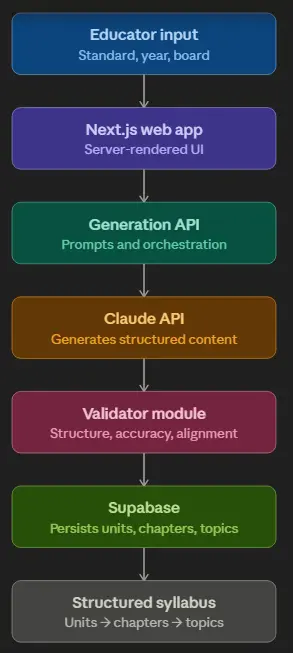
A Next.js application provides a fast, server-rendered web experience for syllabus generation and management. Supabase serves as the backend platform, handling authentication, data storage, and access control, while Claude powers the AI-driven content generation engine.
Next.js - Web application & API routes
Claude API - AI-powered syllabus generation
Supabase - Authentication & backend services
PostgreSQL - Syllabi · Units · Chapters · Topics
Claude Code - Development & iteration environment
Serverless Architecture - Fast generation & scalable deployment
Key Features
- On-the-fly syllabus generation from standard, year, and board inputs
- Structured output organized into units, chapters, and topics
- Persistent storage and editing through Supabase
- Board-aligned content generation using engineered AI prompts
- Web-based platform for faculty and content teams
- Dynamic content management with reusable syllabus records
- Institute-level ownership and customization of generated content